
Immigration Software for Attorneys Compared
Immigration software for attorneys falls into two categories. Case management runs your cases, clients and forms. Case preparation builds the case itself.
Category definitions last reviewed on .
At a Glance
| Criterion | Case preparation platforms | Case management platforms |
|---|---|---|
| Core job | Building the case, from the evidence to the finished filing documents | Running the firm's cases, clients and forms |
| Typical work | Evidence analysis, case outlines, briefs, declarations, RFE responses, expert letters, exhibit lists | Completing government forms, storing client and case data, client communication, tasks and case assignments |
| Where the hours go | Working through evidence and writing the argument | Data entry, client follow-up, task and case administration |
| Examples | Drafty AI, Visalaw.ai, CaseBlink, InceptionAI, Parley | Docketwise, eImmigration, INSZoom, LollyLaw, Imagility, LawLogix, plus Clio, MyCase and Filevine (not immigration specific) |
| Role in the firm | Where the case is built, with matter management for each case | The system of record for cases, clients and firm tasks |
Searches for immigration software for attorneys return two different kinds of product on the same results page, and very little explains the difference. One category manages the case. The other prepares it. Firms that treat them as the same thing tend to buy one, assume it covers both, and keep doing the other half by hand.
Two Categories, Not One Market
Every immigration matter involves two kinds of work. There is administration, meaning completing government forms, keeping client and case records, communicating with clients, and managing the firm’s tasks and case assignments. And there is preparation, meaning everything it takes to build a case strong enough to file, from working through the evidence to writing the argument.
Software developed around each of those separately. Case management platforms are built for the administration. Case preparation platforms are built for the case itself.
What Case Management Software Does
Case management is the firm’s system of record. It is where government forms are completed, client contact and case information is stored, and client communication happens. It also informs the work of the firm itself, meaning tasks, deadlines and who is assigned to which case.
Immigration-specific examples include Docketwise, eImmigration, INSZoom, LollyLaw, Imagility and LawLogix. General practice platforms such as Clio, MyCase and Filevine fill the same role, though they are not built specifically for immigration.
What Case Preparation Software Does
Case preparation is the work between a folder of client documents and a filing that can stand up to scrutiny. Organizing and analyzing the evidence. Identifying what each eligibility element needs and what is still missing. Outlining the case. Writing the brief, the declarations and the expert letters. Responding to a Request for Evidence, which under current USCIS guidance may be your only chance, since officers may now deny a filing without issuing an RFE at all. Assembling an exhibit index that reconciles with everything else in the package.
None of that comes out of an intake questionnaire, because none of it is field data. It is legal work, and in most practices it is the part that runs into the evening.
Examples include Drafty AI, Visalaw.ai, CaseBlink, InceptionAI and Parley.
Where Drafting Fits
Drafting is one stage of case preparation, and it is rarely the first. Before a single paragraph of a brief is written, someone has to work out what the case needs to prove, which evidence proves it, where the gaps are, and how the argument should be ordered. Drafting is the stage where that analysis becomes a document an officer can follow.
That ordering matters more than it used to. USCIS can now deny a filing without first issuing an RFE, and it treats affidavits as tertiary evidence, ranked below primary and secondary documents. A well-written brief sitting on an incomplete evidence record is now a denial risk rather than a draft to be fixed later.
This is why a tool that only writes falls short, however good the prose. The brief has to reconcile with the declarations, the declarations with the exhibits, and the exhibits with every eligibility element. A drafting tool working in isolation leaves that consistency work to the attorney. A case preparation platform treats drafting as one step in a connected workflow, so every document is produced from the same analyzed record.
Why Firms Think They Have Case Preparation Covered
Two reasons, and both are understandable.
The first is that many case management platforms now advertise AI. Where those features exist they tend to cover data extraction from identity documents, template assembly, translation and client correspondence. That is administration made faster, which is useful, and it is not case preparation.
The second is that someone at the firm is already using a general-purpose chatbot, and it seems to work. It does, up to a point, and where that point sits is covered in our Drafty AI vs ChatGPT comparison.
The line between the categories is not perfectly clean. Some newer platforms reach into both. The distinction still holds for the question that matters, which is what each tool was built to do well.
How to Tell Which One You Are Missing
Ask where the hours actually go. If your team loses time to data entry, chasing client documents and rekeying information across forms, the gap is case management. If the forms are complete and the case records are in order but an attorney is still sorting evidence and writing briefs and declarations late at night, the gap is case preparation, and no case management upgrade will close it.
Where Drafty AI Fits
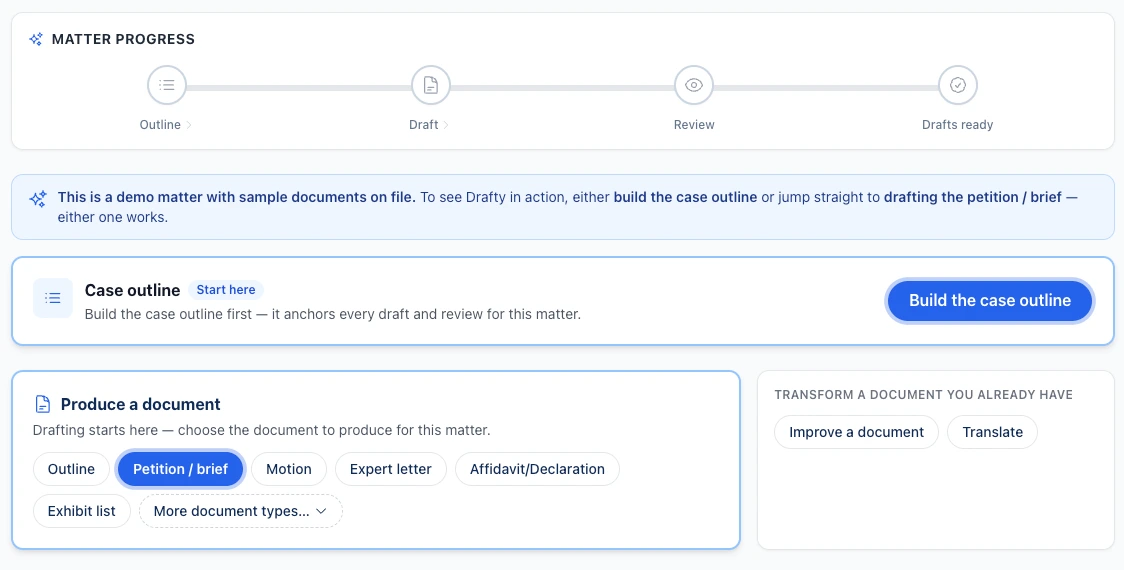
Drafty AI is a case preparation platform with matter management built in. Each matter holds the client’s full document set, and every stage of preparation works from that same record. The Evidence Analyzer reads the documents against what the case type requires. Six studios then carry the case forward, covering the outline, drafting, RFE responses, exhibit lists, expert letters and translation. Drafts are never metered, the matter pool is shared across the firm, and plans start at $250 per month for one seat and ten matters.
Drafty AI was built by immigration attorney Nadine Navarro with an MIT-trained CTO, and is part of the NVIDIA Inception program and MIT’s Venture Mentoring Service, an AILA Startup Alley 2025 member, and an ABA TECHSHOW 2026 Startup Alley finalist.
For a closer look at how the two categories meet in practice, see Drafty AI vs Docketwise. For a head-to-head inside case preparation, see Drafty AI vs Visalaw.ai. Our guide to the best AI tools for immigration lawyers maps the wider field.