
Drafty AI vs ChatGPT for Immigration Law
Drafty AI vs ChatGPT: what a general-purpose assistant cannot do for an immigration filing, and where prompting stops being enough to close the gap.
Pricing and feature details for ChatGPT verified against its public pricing and platform pages on .
At a Glance
| Criterion | Drafty AI | ChatGPT |
|---|---|---|
| Built for | Immigration filings, specifically | General-purpose assistance across every subject |
| Immigration document types | Six studios: drafting, case outline, RFE responses, exhibit lists, expert letters, translation | None built in; you supply the structure on every case |
| Citations | Live legal research integrated into the drafting flow | Fabricated citations from general-purpose models have drawn court sanctions |
| Exhibit assembly | Exhibit List Builder | Not available |
| Your inputs used for training | No | Free and Plus train on conversations by default unless you opt out; Business and Enterprise are excluded by default |
| What you get back | Filing-ready documents | Chat output you reformat yourself |
Drafty AI vs ChatGPT is the comparison most immigration attorneys are actually making, whether or not they frame it that way. Industry data for 2026 puts general-purpose AI use among immigration law professionals at 82 percent, with 58 percent using it for document drafting. The tool you are most often replacing is not another immigration platform. It is a browser tab you already have open.
The Gap Between a General Assistant and a Filing
ChatGPT will produce competent prose about almost anything, including immigration law. What it will not do is know what an I-601A package requires before you tell it, remember that requirement on the next case, or notice that the declaration you just drafted contradicts the exhibit you uploaded twenty minutes ago.
An immigration filing is not one document. It is a hardship brief, several declarations, an exhibit index, a cover letter, and a set of supporting records that all have to agree with each other. The work is structural. A general assistant produces each piece in isolation and leaves the assembly, the cross-checking, and the formatting to you.
Where Prompting Stops Being Enough
Attorneys who get good output from a general chatbot are doing something specific: supplying the legal framework in the prompt. They tell it the elements, the standard of proof, the tone, the structure, the exhibit convention. That works, and it is a real skill.
It is also work you redo on every case, and it caps out. Prompting can tell a model what a good declaration looks like. It cannot give it your firm’s full document set for the matter, check a citation against current authority, build an exhibit index that matches the brief, or stop the same instructions from having to be typed again next Tuesday. At some volume the prompting overhead exceeds the time saved.
The Citation Problem Has Reached the Courts
In 2026 the Ninth Circuit sanctioned two attorneys over an immigration brief containing citations to opinions that did not exist and quotations invented from real cases. Each was fined $2,500 and suspended from practice before the court for six months, and both were ordered to send the order to their clients and opposing counsel.
General-purpose models generate plausible citations because plausible text is what they produce, and nothing in a consumer chatbot anchors that output to current immigration authority. Drafty AI integrates live legal research into the drafting flow itself, so a draft is produced against a vetted set of legal sources rather than from a public model’s recollection. The attorney still reviews and signs off. That responsibility does not move, and no tool should suggest otherwise. Our guide on whether AI is safe for immigration law firms covers the wider risk picture.
What Happens to Client Facts You Paste In
This one has a nuance worth getting right. ChatGPT Business and Enterprise exclude customer conversations from model training by default. The consumer tiers do not: Free and Plus are used for training unless the user finds the setting and opts out.
That matters because Plus, at $20 a month, is what most solo and small-firm attorneys are actually running. The plan that excludes your client facts from training by default is not the plan on most laptops. Only 8 percent of immigration firms have a written AI policy, so in practice very few teams have checked which tier their staff are using or whether anyone flipped the setting. Drafty AI does not use your data to train models on any plan. If you need to put rules around this at your firm, our AI use policy template is a starting point.
What the $20 Does Not Include
The price gap is real and it is the first thing anyone notices. It is also the wrong unit of comparison, because the two products are not sold against the same job.
A ChatGPT subscription buys a capable general assistant. It does not buy immigration document structures, evidence analysis, exhibit assembly, case-level document handling, or filing-ready output. Those remain your work, priced at your hourly rate, on every matter. The question is not which subscription costs less. It is what each one leaves on your desk afterward, and how many hours that is worth across a filing season. Our breakdown of the best AI tools for immigration lawyers maps the four tool categories and where each one genuinely fits.
What Drafty AI Does Instead
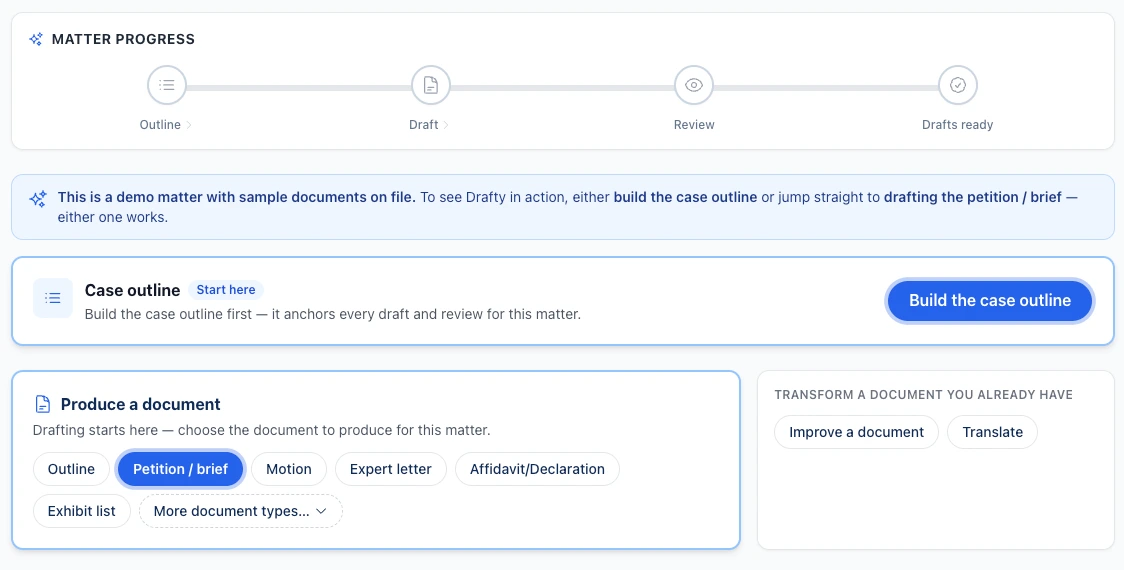
Drafty AI has been drafting immigration documents since June 2023, built by Nadine Navarro, a practicing immigration attorney. Six studios cover drafting, case outline, RFE responses, exhibit lists, expert letters and translation. A matter holds the case’s full document set, so the tool works from the record rather than from whatever you remembered to paste. Drafts are never metered, so nobody on the team hesitates before a second pass.
Plans start at $250 per month for one seat and ten matters. See the plan builder, compare against another immigration-specific platform in our Drafty AI vs Visalaw.ai comparison, or try the output first with our free AI tools for immigration attorneys, which need no account.